Ten years. Six hundred schools. Twenty-five countries. Every single one cared deeply about wellbeing, and every single one was getting it wrong the same way. Here is the crack I kept seeing, and the data that finally proved the fix.
I've spent the last ten years of my life inside schools. Not one school. Not one system. Through The School of Play, I've run workshops in over 600 schools across more than 25 countries. City schools and village schools. Elite campuses with theatres bigger than my first apartment, and one-room schools where the stage was a patch of dirt and the lighting rig was the sun.
Different languages. Different cultures. Different curriculums. And one thing, one thing was exactly the same everywhere I went.
Let me be clear: the schools weren't the problem. I've never met a principal who didn't genuinely care about their students' mental health. I've watched teachers give up lunch breaks, weekends, and pieces of themselves trying to support struggling kids. Schools were doing wellbeing weeks. Wellbeing surveys. Wellbeing frameworks. Guest speakers. Posters in every corridor telling kids to be resilient.
But standing in those halls, workshop after workshop, country after country, I kept seeing the same crack running through all of it:
Every single wellbeing program was adult-led. Designed by adults. Delivered by adults. Measured by adults. Teachers already stretched to breaking point, handed one more thing to run. Students handed one more thing to sit through.
And the kids could feel it. Wellbeing had become something that happened to them. Like a fire drill. They had no voice in it, no ownership of it, and no agency over the one thing that was supposedly all about them: their own wellbeing.
Six hundred schools. Twenty-five countries. Same crack, every time.
Sit down with any school leader, and I've sat down with hundreds, and the same three pain points come up. Every conversation. Every country.
Belonging. Whether students feel safe, connected, and like they truly belong. It's now a headline measure in strategic plans around the world, because belonging drives everything else: attendance, engagement, learning, retention. But here's the uncomfortable truth: you cannot instruct a child to belong. A program delivered from the front of the room doesn't create connection. Kids build connection with each other or not at all.
Engagement and attendance. Attendance is the number every school gets measured on, and disengagement is the quiet crisis sitting underneath it. Schools know a student who doesn't want to be there won't learn. But another adult-led session about resilience is not what makes a kid want to come to school on a Monday morning.
Finding the kids who need help, before it's too late. Nearly half of young people report high levels of psychological distress. Schools are desperate for honest, early signals about how their students are really doing. But students don't open up in a survey they were told to fill in, during a program they were told to attend. Adult-led wellbeing produces adult-shaped answers.
Three enormous pain points. And after ten years on the ground, I was certain they all shared one root cause:
The answer was in front of me the whole time. It was the reason The School of Play worked. In ten years of workshops, I never once had to force a kid to participate. I watched students run, actually run to be part of it. I watched the shy kid in the back row become the loudest voice in the room. I watched kids who "never engage with anything" take complete ownership, lead their peers, and light up.
Why? Because it was fun. Because it was theirs. Because they led it. Nobody ever had to drag a kid into play. You had to drag them out of it.
And one day it hit me like a spotlight: what if wellbeing worked the same way? What if, instead of adults delivering wellbeing at students, we handed students the keys? That is the day The Better Us Project was born.
The Better Us Project takes everything schools are fighting for: belonging, engagement, real insight into how kids are doing. It delivers it the only way I have ever seen actually work: student-owned, student-led, and genuinely fun.
Students choose it. Students run it. Students own it. Teachers finally get to step out of the exhausting role of program-deliverer and into the role they always wanted: supporter, encourager, safety net.
And when students own their wellbeing, all three pain points start to move at once:
I believed in this model with everything I had. Ten years and six hundred schools will do that to you. But I'll be honest, even I wasn't ready for what the last three months of Better Us data showed.
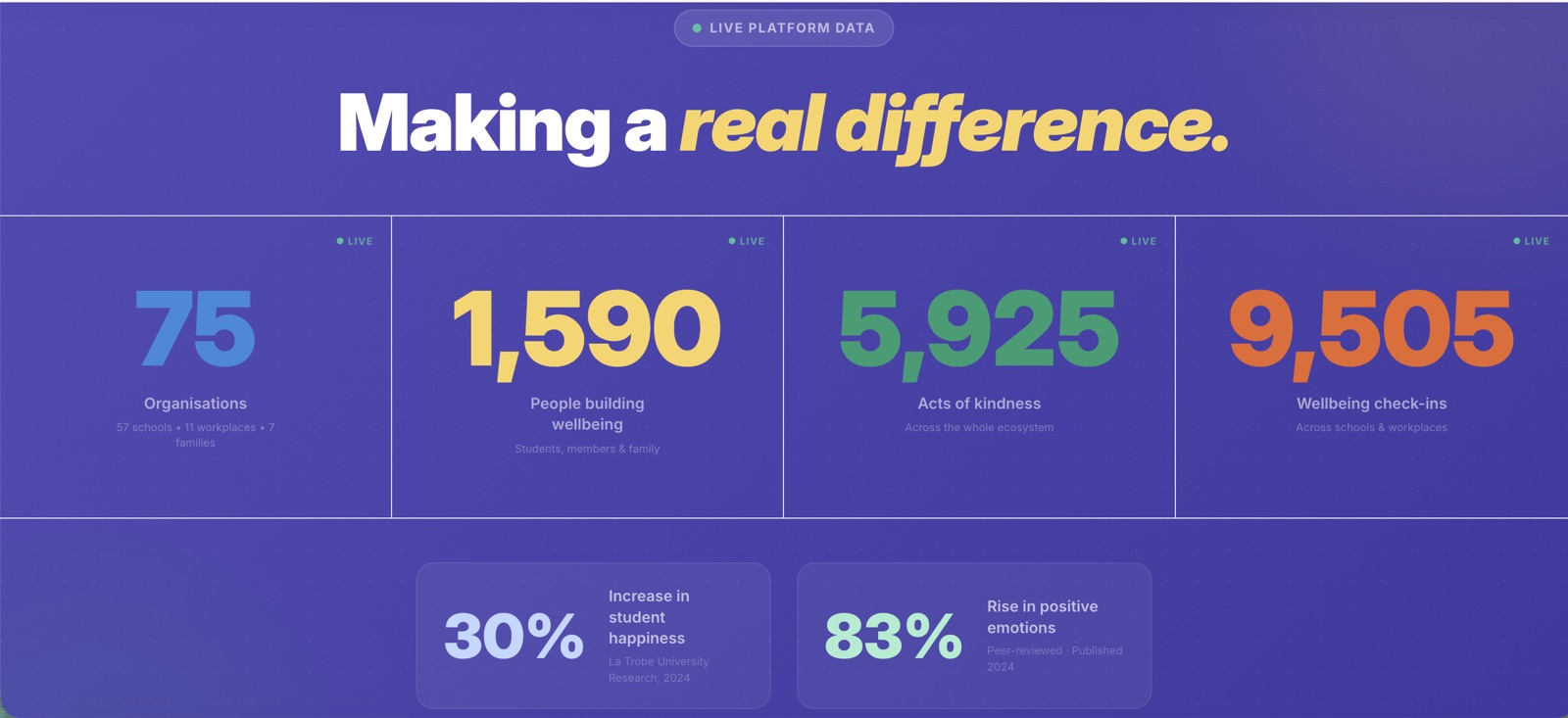
This is the whole ecosystem, live. Not a survey run once a year. Not a snapshot taken by an adult. Every one of these numbers was created by young people choosing to take part.
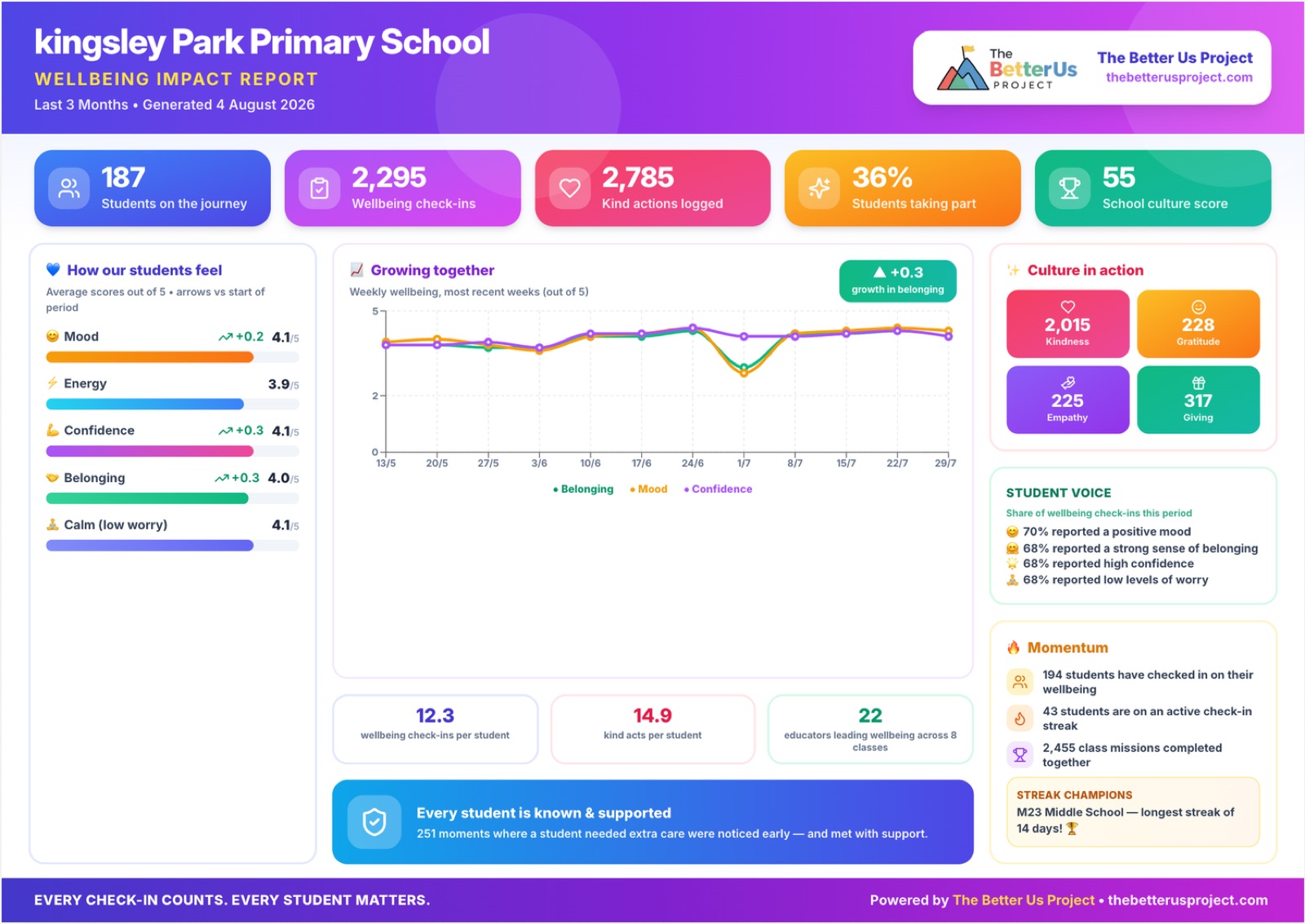
Then zoom into a single school. This is one primary school over three months: 187 students on the journey, 2,295 wellbeing check-ins, 2,785 kind actions logged. Belonging up 0.3. Confidence up 0.3. Mood up 0.2. And 251 moments where a student needed extra care were noticed early and met with support.
And here is the part that still gets me. Line the results up against the exact three pain points every leader raises, and they answer all three at once. 7,866 wellbeing check-ins captured. 5,336 kind actions logged. 62% of enrolled students actively taking part, not because they were told to. And 465 students identified for early support, flagged the same day rather than months later.
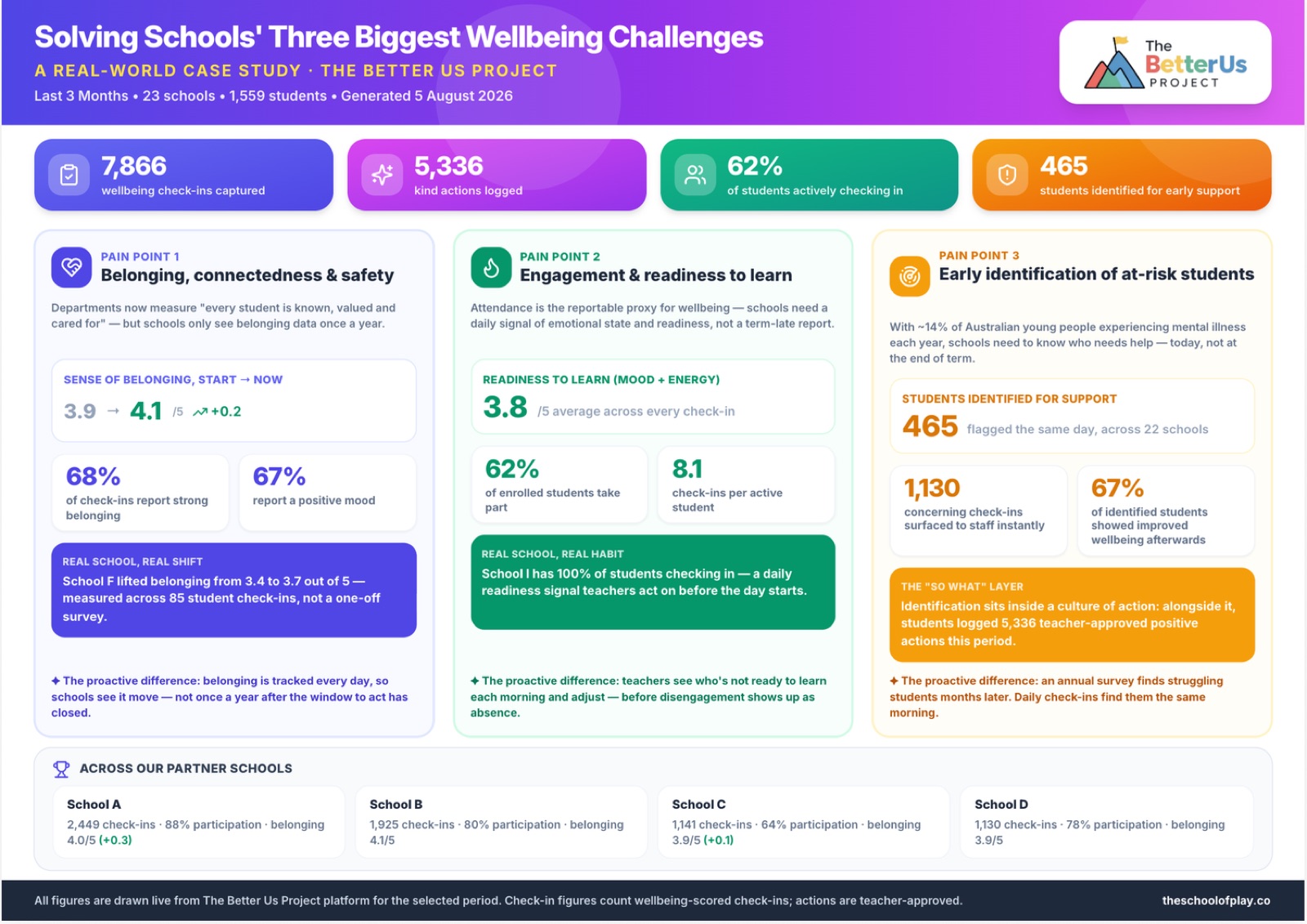
An annual survey finds a struggling student months later. Daily check-ins find them the same morning.
Schools don't have a wellbeing measurement problem. They don't have a wellbeing program problem. They have a wellbeing ownership problem. Hand students genuine agency over their own wellbeing, make it fun, make it theirs, and belonging, engagement and honest, actionable insight stop being things you have to chase.
They show up on their own.
Just like the students do.
Want to see what student-owned wellbeing looks like in your school? Get in touch with The Better Us Project.
Explore The Better Us ProjectA printable 2-page summary with the key takeaways. Perfect for staffroom walls, fridge doors, or the back of a planner.
After two decades in schools and twenty more research papers, the answer is clear, but the way we deliver it has to change. Here's why play is no longer optional.
Why most brain breaks fail (you're not being weird enough) and the four formats that work in any year level.
Most wellbeing programs ask for a whole day. The ones that actually stick ask for five minutes. Here's the research, and a script for Monday morning.